What happens between us when we interact?
How do we understand this “in-between”?
How do we navigate the in-between, while also self-regulating and attending to others?
How do we participate in one another’s sense-making?
How do we make sense of the world together?
What role does the experience of interacting play in all this?
How to bring embodiment and interactive dynamics properly into social cognition research?
How to research intersubjectivity, while doing justice to the role our whole bodies, and the emergent dynamics between us play in it?
What
PRISMA is a method to embody social interaction research and to cultivate intersubjective capacity.
In a PRISMA workshop/experiment, participants engage in live interactions, and refract the experience of what happens between them (like a prism refracts light).
Participant-researchers interact in different roles, take different perspectives, and sense, feel, and think about what it is like to participate in interaction processes.
Using the PRISMA systematic protocol, you can:
- Experiment with what it is like to participate,
- Conduct research on the experiential dynamics of interpersonal coordination and participatory sense-making,
- Gain awareness and insight into participatory dynamics,
- Cultivate trust and confidence,
- Better understand processes of participatory sense-making.
PRISMA is used in research, in facilitation, in professional and personal development, and in teaching.
By deepening the experience of participating in interaction dynamics and giving words to it, participants gain intersubjective awareness and insight, and become more able to navigate intersubjective complexity.
Origins
The PRISMA method was originally developed by Barbara Pieper, social scientist and Feldenkrais© practitioner in Munich, and Daniel Clénin, actor and Feldenkrais© practitioner in Bern, in a project of the International Feldenkrais Federation for developing quality and competency in Feldenkrais professional practice.
The practical-theoretical approach of PRISMA also proved suitable for development in diverse professional fields, including science and research.
In 2009, philosopher and cognitive scientist Hanne De Jaegher joined Barbara and Daniel, and since then it has been used in embodied intersubjectivity research on the dynamics of participatory sense-making.
Publications
- Paradoxical practices of being with others: Some experiential dynamics at play while interacting across differences. Hanne De Jaegher, Rika Preiser, Elena C. Cuffari (2025) Language Sciences
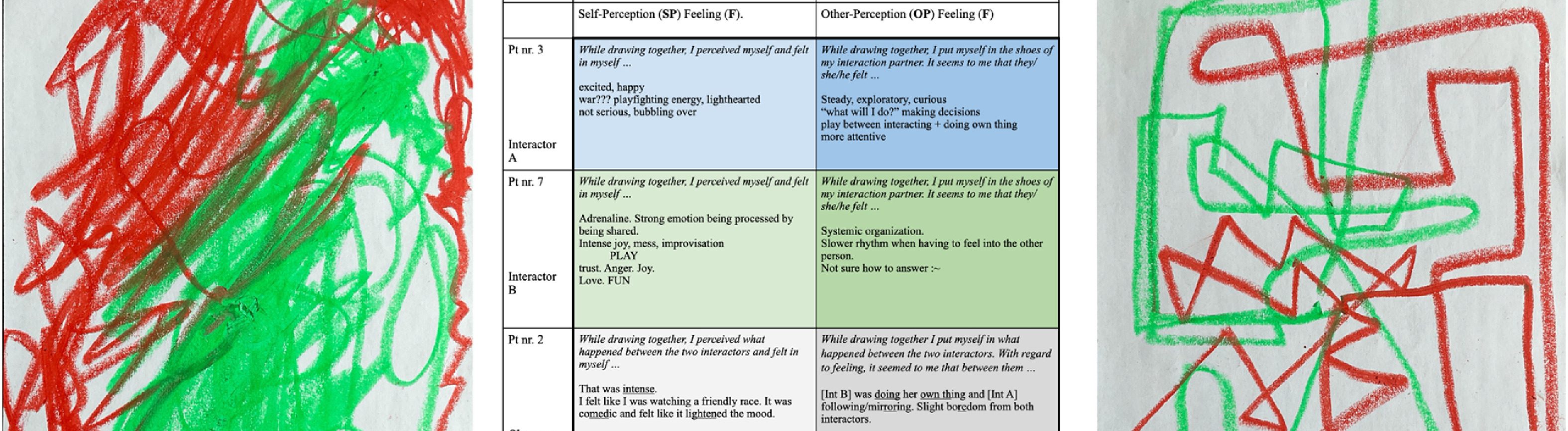
- Grasping intersubjectivity: an invitation to embody social interaction research.
Hanne De Jaegher, Barbara Pieper, Daniel Clénin, Thomas Fuchs (2017)
Phenomenology and the Cognitive Sciences
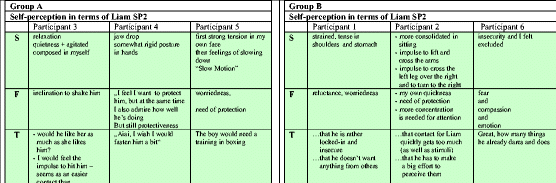
- „Verkörperte Selbst- und Fremdwahrnehmung sozialen Handelns. Eine praktisch-theoretische Forschungsperspektive“.
Barbara Pieper and Daniel Clénin, in Die Körperlichkeit sozialen Handelns. Soziale Ordnung jenseits von Normen und Institutionen
> download chapter as PDF (Deutsch)
> download chapter as PDF (English)